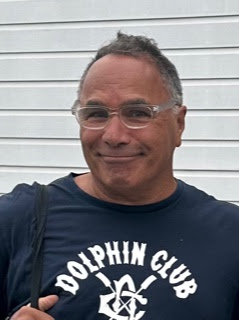
When the Dolphin Club was founded in 1877, the primary athletic interest was competitive rowing. This was during a time when the Whitehall rowboat was the workhorse of San Francisco Bay. Speed was the issue with these boats. The design also enabled them to handle the harbor chop and yet track straight. This was a critical business asset in the days when the first buyer to reach a cargo ship sailing into San Franciso Bay gained first dibs to drayage rights. As a result, winning rowing races was a mixture of sport, gambling, and business advertisement.
The city directory listed many residents with occupation as
“boatbuilder.” One of these was Thomas Keenan who owned his own shop on
Jefferson Street. The Club contracted with Keenan who built numerous boats for
our club and others. He built our Chas M Farrell in 1917 which is still
in use. He became a Dolphin Life Member.
 |
| Jon Bielinski |
With our boat shop lacking a professional builder, this was another period when the fleet slipped into disrepair. Well-meaning members tried their hand. However, even talented carpenters and those with construction experience did not have the specialized skills for Whitehall repair and construction. Herman Zahler, who joined the club in 1972, would tackle any project big or small. For example, he constructed the new locker rooms and rebuilt the pier. Although he made the flat-bottom utility boat named Horse, there’s no record of him attempting more complex work on lapstrake Whitehall boats.
In late 1983, Dino Landucci gained board acceptance to fund restoration of the boat that was named after him. A rigger on the Balclutha learned about the project and told his friend, Jon Bielinski. Jon came to look at the job and found the boat in a sad state. It had a broken keel, broken frames, broken bottom planks, and broken thwarts making the vessel completely unseaworthy. The Club hired Bielinski to undertake the restoration. He packed up the boat parts and sailed them to Sausalito to duplicate the parts at the Sausalito Shipwrights Cooperative there. He sailed the refurbished parts and material back to the Dolphin Club and reassembled the boat. Once that was done, the Landucci stood in stark contrast to the other dilapidated, maintenance-deferred boats at the time.
Jon’s achievement with Landucci led the Club to continue
funding his work on the rest of the fleet. The fleet enlarged with the addition
of Cecco and Bruno, built from scratch. This engendered a real
interest on the part of club members in how the boats went together. Jon was
happy to support this activity. His experience with boat building was that
there was mutual benefit to work with other boat builders at the Cooperative in
Sausalito. But it turned out that the effort needed some organization and led
to the beginning of “Boat Night.” Instead of haphazard, ad hoc “one-on-one”
tutelage, the Club scheduled a 3-hour period of group boat maintenance each
Tuesday night with a little bite to eat. More and more people began to
participate, and it became the mainstay of the effort to maintain the fleet,
providing far more labor than Jon could as a single individual. Boat Night has
been in place now for 43 years and the fleet receives regular maintenance
attention as reflected in the meticulously recorded Varnish Record. A reliable
estimate puts the total volunteer time devoted to the boats during this period
over 200,000 hours.

Beyond boat maintenance and building, Boat Nights foster
community and education. Diane Walton points out that tasks are distributed
according to a volunteer’s capacity to “give and not harm.” In her case, before
graduating to power tools, she was assigned to sand oarlocks. At some point,
the guy standing next to her was wearing coveralls and clearly had skills.
He watched Diane for a while and then said, “Can I ask you a question?” She
consented and he followed up with, “What are you thinking about?” Clearly
flummoxed, she responded, “I’m just trying to do my chore. What made you ask me
that?” He said that a principle he had learned was that you leave a part of
yourself on everything you touch. At this point Diane is wondering if maybe
she’s speaking with the philosopher king of Boat Shop. He followed up with a
suggestion that she “just be bigger. Be more you with the sandpaper and
oarlock.” She says, “Then he disappeared. I’ve not seen him again, but it’s
that kind of magic that happens in here that just knocks me out! I’m wildly
appreciative of the work that happens here. Not only for the boats, but for the
members who choose to come.”
The sense of community extends beyond the Dolphin
membership. Todd Bloch tells of a Boat Night when the weather was at its most
gorgeous and the Jefferson street doors of the Boat Shop were open. An Italian
family wandered by and were “blown away by the work that was going on.” Jon
Bielinski invited them in for a closer look. “They ended up spending the whole
evening working on the boat with us. They thought it was the greatest part of
their trip.” He says the community outreach extends beyond the Boat Shop. “When
I row down the Bay in front of Pier 39, all the cameras come out. People are
taking pictures of the rowboat with Alcatraz in the background. You actually can
distract people from the sea lions by rowing past them in a beautiful wooden
boat.”

Probably the starkest example of the long-term impact of
exposure to the Boat Shop and Boat Night is Kal Kini Davis. He started coming
to Boat Night when he was 16 years old with parental supervision. Nanda
Palmieri says, “He didn’t have boat-building skills, but he was a quick
learner. He really got into boat
building and that was wonderful to see. I think he had difficulties fitting
into school and Boat Night meant a lot to him and helped him figure himself out
and he really engaged with the people and the work in a very meaningful way.”
Kal ended up going to the Northwest School of Wooden Boat Building, following
in the footsteps of Julia Hechanova. He is now at the Rhode Island School of
Design. He is the co-author of the novel The Uncertainty Principle. In
the afterword, he gives a heart-warming shout-out to his experience at the
Dolphin Club. “When I was sixteen, I walked into the boat shop at the Dolphin
Club in San Francisco and was welcomed by master builders Jon Bielinski and
Julia Hechanova. They introduced me to the world of wooden boats and inspired
me to apply to the Northwest School of Wooden Boatbuilding. I was accepted, and
now, every weekday, I wake up excited to learn about the properties of
different wood species or how to plank a boat. Thank you to Jon and Julia for
showing me the way here.”
Anton Huttner is the program director at the youth
development organization, Rocking the Boat. He brought a group to the
Boat Shop. He says:
“They had some
concept of what we are about, but they hadn’t seen that level of craftmanship.
Julia Hechanova gave us a tour and her knowledge and expertise was really
something. It definitely opened their horizon. They were really taken with the
knees and breasthooks that were cut out of grown, natural tree features. At Rocking
the Boat, we don’t have those cultured refinements. I feel like places like
the Dolphin Club can inspire people to pick up the skills and take the torch
and who know where it goes from there?
People with a lot of skill and know-how are keeping the
fleet alive and that is essential. The boats, by themselves, with the use they
are getting, if they don’t get looked after the way they are looked after right
now, it is a very quick downhill. They are such fragile vessels; they need the
love and care they get from the people who look after them. I cannot imagine
that there are a lot of places that have treasures like that. The stewardship
is at the top-tier level, and the quality of the boat shows it.”
John Muir has been a Club member for over 30 years. He works
next door in the small boat shop at the National Park Service as a curator of
small craft. He is a craftsman and a preservationist. He is careful to say that
he is speaking as a Club member only and not as an official of the Park
Service. “I just want to emphasize that Jon [Bielinski] is not only an amazing
boat builder; he’s a national treasure. In my experience working with museums
and craftsmen and preservationists around the country and in Europe, Jon is of
the highest echelon. And he's also brought in an apprentice that shows very,
very strong promise. We have been able as a club to reap the reward of a level
of craftsmanship and a fleet that is a national treasure. It's not just ‘our Club
is cool.’ This is really cool! Honestly, it's hard to describe the value
of building in-house skill and craftsmanship like this.”